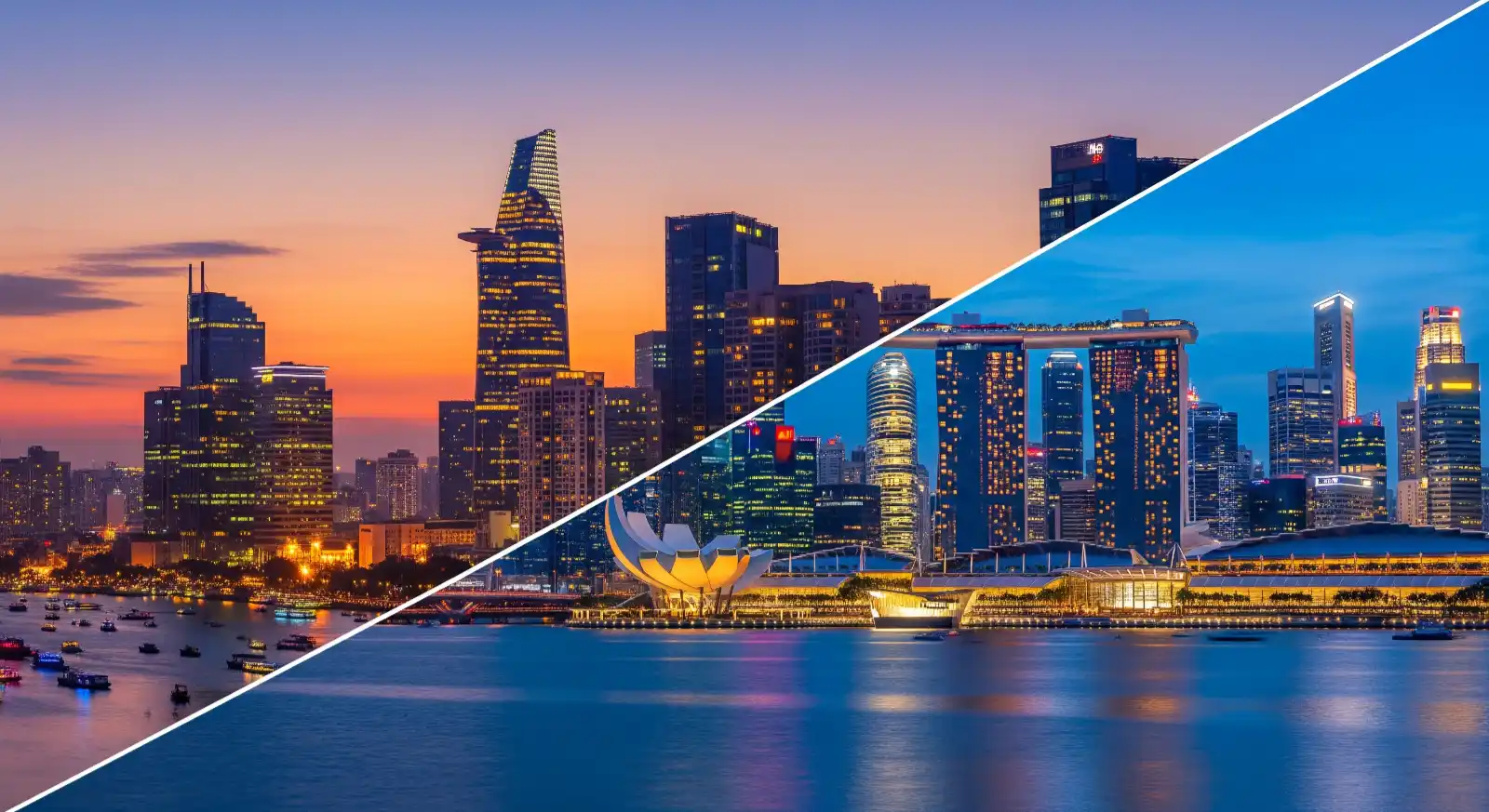
Singapore has earned a global reputation as Asia's gold standard for healthcare. It boasts world-class hospitals, exceptional regulation, and surgeons trained at the best institutions in the world. But for hair transplant patients specifically, that premium positioning comes with prices that run $4,500 to $11,000 for a procedure that costs $1,500 to $3,500 in Vietnam.
The gap isn't a quality compromise. It reflects fundamental differences in how each country's hair restoration market is structured and priced. Here's an honest comparison of cost, quality, surgeon expertise, and recovery, including why Vietnam's specialized boutique model often delivers more focused expertise per dollar than Singapore's broader medical infrastructure.
If you're weighing Singapore against Ho Chi Minh City for your hair restoration, this comprehensive guide will help you decide which destination is right for you.
Two Different Healthcare Models
Singapore has built its medical reputation around comprehensive, hospital-grade quality. The country's healthcare system consistently ranks among the world's best, with strict licensing through the Ministry of Health and the Singapore Medical Council, JCI-accredited hospitals serving international patients, and a regulatory environment that's among the strictest in Asia. For complex medical care — cardiac surgery, oncology, neurosurgery — Singapore is a genuine global destination.
Hair restoration in Singapore exists in two segments. A handful of clinics have positioned as specialized hair restoration practices with hair restoration as their primary or sole focus. Alongside this specialized segment, a larger number of general aesthetic clinics and dermatology practices offer hair transplants as part of broader service menus that include cosmetic injectables, laser treatments, and skin procedures. Both segments are well-regulated and produce competent results; the difference shows up in patient volume, focus, and overall expertise depth.
Most of Vietnam's leading hair restoration clinics have built around the specialized model exclusively. Top Vietnamese clinics handle hair restoration as their primary practice, with lead surgeons holding international credentials (many trained in Singapore, South Korea, Japan, or Europe) and bringing those techniques back to dedicated boutique practices. The result is a different overall market structure. Vietnam's top-tier hair restoration scene is concentrated in specialized boutiques, while Singapore's market includes both specialists and generalists at the top tier.
This isn't about Singapore versus Vietnam in healthcare generally. It's about how each country's hair restoration market is structured at the procedure-specific level.
Cost Comparison: Vietnam vs Singapore
Singapore typically charges between $4,500 and $11,000 for a 2,000-graft FUE procedure, with premium clinics on Orchard Road and in Singapore's central business district pushing higher. Robotic FUE (ARTAS, NeoGraft) and premium DHI procedures often run $7,000 to $15,000 or more, with the highest-end Singapore clinics quoting up to $20,000+ for complex cases. Singapore's pricing reflects some of the highest medical operating costs in Asia due to premium real estate, strict regulatory overhead, high-skilled medical labor, and the country's positioning as an international medical hub.
Vietnam offers comparable procedures from $1,500 to $3,500 — roughly 60% to 75% less than equivalent Singapore clinics for standard FUE, and a wider gap at the premium end. This isn't a quality compromise; it reflects Vietnam's fundamentally lower operating costs and the boutique specialization that defines its top hair restoration clinics.
For Singapore residents and regional patients, the savings extend significantly beyond the procedure itself. Singapore is one of the world's most expensive cities for accommodation, dining, and transport, meaning even a short medical trip locally adds substantial cost. Vietnam's costs across every category are dramatically lower, meaning a full medical tourism trip — including a week of recovery at a quality hotel — often costs less than the Singapore procedure alone.
For larger procedures (3,000-4,000+ grafts), the cost gap widens further. Singapore pricing scales steeply with graft count; Vietnamese clinics maintain more consistent per-graft pricing into larger sessions.
Quality of Care and Medical Standards
Singapore's medical regulation is genuinely exceptional. Medical practitioners are licensed through the Singapore Medical Council, which enforces some of the most rigorous credentialing standards in Asia. Clinics operate under Ministry of Health licensing, complaint mechanisms are well-established, and patient protections are strong. For patients prioritizing maximum regulatory certainty, Singapore offers genuine peace of mind that's worth paying for.
Vietnam has been quietly building a specialized hair restoration sector that matches Singapore-level technical standards while operating in a different regulatory context. Leading Vietnamese clinics:
- Employ surgeons with international training credentials (many trained in Singapore, Korea, or Western institutions)
- Use the same equipment, instruments, and materials as Singapore clinics
- Specialize narrowly in hair restoration, building deep expertise from focused case volume
- Operate under Vietnam's Ministry of Health licensing framework, which legally requires surgical procedures to be performed by qualified physicians
- Provide detailed pre-operative consultations and structured aftercare
The distinction isn't quality at the top end. It's variation. In Singapore, regulation sets a uniformly high bar, so even mid-tier clinics meet strict baseline standards. In Vietnam, the gap between premium and budget clinics is wider, which is precisely why clinic selection matters more when traveling abroad. A vetted Vietnamese clinic operating at the top of the market is genuinely comparable to a quality Singapore clinic but the unvetted bottom end is a different category of risk entirely. This is why we don't list every clinic that approaches us. Read about how we evaluate and select the clinics we work with →
The Structural Difference: Market Concentration
Any honest comparison of hair transplantation in Singapore and Vietnam needs to address a feature of each market that isn't widely discussed.
Singapore's hair restoration scene is fragmented across two segments: a small group of dedicated hair restoration specialists and a larger pool of multi-service aesthetic clinics and dermatology practices where hair transplants are one of several procedures offered. Both segments are properly regulated; the difference is in patient volume and specialization depth.
A dermatologist or plastic surgeon at a multi-service clinic accumulates broad aesthetic experience but spreads attention across several procedure types. A surgeon at a dedicated hair restoration clinic concentrates their entire practice on hair work. Both can produce excellent results, but the specialist concentration tends to show up in subtle outcomes: hairline naturalness, donor management for future procedures, and technique refinement for difficult cases.
Vietnam's top-tier hair restoration market is concentrated more uniformly in the specialized boutique segment. Leading Vietnamese clinics handle hair transplants exclusively or near-exclusively, with smaller patient volumes per day than typical multi-service aesthetic operations. The surgeon you consult with is the surgeon who operates on you.
For straightforward cases, the difference between Singapore's mixed market and Vietnam's concentrated specialist segment may not significantly affect outcomes. Both can deliver excellent results. For complex cases (advanced Norwood patterns, prior failed procedures, unusual donor characteristics, ethnically diverse hair types), specialist experience tends to produce better outcomes. Vietnam's market concentration in specialists means a patient choosing carefully has a higher possibility of landing at a specialist clinic. In Singapore, the patient bears more responsibility for distinguishing between specialist and generalist providers within a more mixed market.
This is the genuine trade-off in choosing Singapore: you're paying for Singapore's premium regulatory environment and overall medical infrastructure, but the specific hair restoration expertise depth may not consistently match what concentrated specialist markets deliver elsewhere in Asia at lower cost.
Techniques and Technology
Both countries offer the modern range of hair transplant techniques:
- FUE (Follicular Unit Extraction) — the most common minimally invasive technique
- DHI (Direct Hair Implantation) — using Choi implanter pens for precise placement
- Sapphire FUE — sapphire blades for cleaner incisions
- Long Hair FUE — preview results immediately
- FUT (Follicular Unit Transplantation) — older strip method, still useful in specific cases
- Beard and eyebrow transplants — both countries offer these
Technology and equipment are essentially identical at the top end. Top Vietnamese clinics invest in the same systems and instruments as their Singapore counterparts. The cost difference reflects operating overhead, not capability gaps. Any meaningful technique innovation makes its way through the international medical community within a year or two; what you receive in Vietnam is essentially the same procedure available in Singapore.
Surgeon Expertise and Patient Demographics
Singapore clinics primarily serve domestic Singaporean patients, regional expats from across Southeast Asia, and international medical tourists drawn to Singapore's premium reputation. Singaporean surgeons typically have broad international training and are comfortable treating diverse patient demographics. Singapore's multicultural patient base means familiarity with Asian, Caucasian, and South Asian hair characteristics.
Vietnam's leading hair restoration clinics have built similarly broad expertise, routinely treating patients from Australia, the US, the UK, Germany, France, the Middle East, Korea, Japan, Singapore itself, and across Southeast Asia. Vietnamese surgeons are accustomed to designing hairlines and customizing techniques for Caucasian, African, Hispanic, Middle Eastern, and Asian hair types. Some Vietnamese surgeons have trained in Singapore at some point in their careers.
Travel and Logistics
Singapore is one of Asia's most accessible international destinations, with Changi Airport serving as a major regional hub. Direct flights connect Singapore to virtually every major city worldwide. Visa requirements are minimal for most nationalities. English is the language of medicine and business, and the city's infrastructure is exceptional.
Vietnam has strong connectivity through Ho Chi Minh City (Tan Son Nhat) and Hanoi (Noi Bai), with direct flights from Australia, Europe, North America, and across Asia. Vietnam's e-visa system is simple, and many nationalities qualify for visa-free entry. English is widely spoken in medical and hospitality settings in major cities.
For Singapore residents specifically, the flight to Ho Chi Minh City is just over 2 hours direct on multiple daily services from Singapore Airlines, Vietnam Airlines, VietJet Air, and Scoot. This makes Vietnam genuinely accessible for a hair transplant trip without significant travel burden. From regional hubs like Jakarta, Kuala Lumpur, Manila, or Bangkok, Vietnam is similarly close. For Australian, European, or North American patients comparing the two destinations, travel time to either is similar.
Recovery Environment
Singapore is a fascinating, hyper-modern city but it's also intensely urban, fast-paced, and among the most expensive cities in the world. Recovery in Singapore means navigating a major metropolis with limited options for restorative coastal alternatives. Singapore's tropical climate is suitable for recovery, but the urban density and pace don't always support relaxed healing.
Vietnam offers a notably more restorative recovery experience. Ho Chi Minh City and Hanoi provide modern amenities and excellent cuisine at much lower prices. For coastal recovery, Hoi An's UNESCO heritage town, Phu Quoc's tropical luxury resorts, and Da Nang's beaches provide ideal healing environments and all are easily accessible by short domestic flights. The tropical climate is consistent year-round, and the more relaxed pace genuinely supports recovery. For a full breakdown, see our guide to planning your hair transplant trip →
Many international patients combine their Vietnam procedure with a proper holiday, something that's difficult to arrange affordably in Singapore.
Aftercare and Follow-Up
Top Singapore clinics provide thorough aftercare with detailed protocols. However, multi-service aesthetic clinics often have larger overall patient bases than specialized hair restoration practices, which can mean less personalized post-operative attention for hair transplant patients specifically.
Vietnamese clinics serving international patients place strong emphasis on long-term patient relationships. Most provide multiple video consultations over 12 months, responsive English-language communication, and detailed growth tracking. The smaller patient volumes at boutique Vietnamese hair restoration clinics translate directly to more attentive aftercare, particularly through the months 4-12 window where most growth questions arise.
Which Should You Choose?
Choose Singapore if: Budget is not a primary concern, you place high value on Singapore's premium regulatory environment, you have complex medical conditions benefiting from Singapore's hospital-grade infrastructure, you specifically want a Singapore-credentialed surgeon, or convenience and familiarity outweigh cost considerations.
Choose Vietnam if: You want premium-quality results without premium pricing, prefer specialized hair restoration boutiques over multi-service aesthetic clinics, value a more relaxed recovery environment, or want to combine your procedure with an affordable extended holiday.
For Singapore residents specifically, the math is unusually compelling: a 2-hour flight delivers you to specialized clinics at one-quarter to one-third of Singapore pricing, with the option to recover in relaxing coastal settings rather than continuing your daily routine through the awkward post-procedure weeks.
Final Thoughts
Singapore deserves its reputation as Asia's gold standard for healthcare. Its regulatory environment is exceptional, its top surgeons are world-class, and for many medical decisions, Singapore is genuinely worth the premium it commands. But hair restoration is a specific category where the value math works differently than for complex surgery. The procedure is office-based, the specialist model often outperforms the generalist medical center model, and the cost differential to Vietnam is dramatic enough that even modest differences in regulatory environment don't justify the gap.
For most healthy adult patients undergoing hair restoration, a properly vetted Vietnamese clinic delivers quality genuinely comparable to Singapore at roughly 25-35% of the all-in cost. The remaining 65-75% can fund a proper recovery trip or simply stay in your bank account.
If you're weighing Singapore against Ho Chi Minh City, the question isn't whether Singapore's healthcare is excellent. It is. The question is whether the cost differential makes sense for a specific procedure where boutique specialization tends to outperform institutional infrastructure. For increasing numbers of regional patients, the answer is no.