South Korea has earned its reputation as Asia's aesthetic medicine capital — but Vietnam now offers comparable surgical expertise at 60-75% lower cost. Here's an honest comparison of cost, quality, safety, and recovery between Seoul's premium clinics and Vietnam's specialized hair restoration destinations, including what every patient should know about Korea's ghost doctor concerns.
If you're choosing between Seoul and Ho Chi Minh City for your hair restoration journey, this comprehensive comparison will help you decide which destination delivers the best value for your needs.
Two Different Approaches to Excellence
South Korea has built a global brand around precision, technology, and aesthetic perfection. Korean clinics are famous for advanced techniques, meticulous attention to detail, and surgeons who often hold international fellowships and publish in peer-reviewed journals. The country processes hundreds of thousands of medical tourists annually, with hair transplants forming a significant slice of that market.
Vietnam has taken a different path — building specialized hair restoration clinics that match Korean technical standards while operating at dramatically lower costs. Leading Vietnamese clinics employ surgeons trained in Korea, the US, Europe, and Japan, often bringing international techniques back home to deliver world-class results to a broader range of patients.
The choice isn't about quality versus affordability. It's about which premium experience suits your priorities and budget.
Cost Comparison: Vietnam vs South Korea
South Korea typically charges between $5,000 and $12,000 for a hair transplant, with top Gangnam clinics pushing higher for premium DHI procedures or celebrity-tier surgeons. Korea sits at the upper end of Asian medical tourism pricing, reflecting its premium positioning and high operating costs in Seoul.
Vietnam offers comparable procedures from $1,500 to $3,500 — often 60-75% less than equivalent Korean clinics. This isn't a quality compromise; it reflects fundamental differences in operating costs, clinic overhead, and Vietnam's positioning as a value-focused destination.
For international patients, the savings extend significantly beyond the procedure. Seoul is one of Asia's most expensive cities for accommodation, dining, and transport. Vietnam's costs across every category are dramatically lower, meaning a comprehensive medical tourism trip — including extended recovery — often costs less in total than the Korean procedure alone.
Quality of Care and Medical Standards
South Korea's medical reputation is genuinely exceptional. Korean surgeons are pioneers of techniques like non-shaven FUE and have refined DHI to an art form. Top Seoul clinics operate with hospital-grade facilities, comprehensive consultation processes, and strict regulatory oversight.
Vietnam has rapidly elevated its standards to compete at this level. Leading Vietnamese hair transplant clinics:
- Employ surgeons with international training credentials
- Use the same equipment and materials as Korean clinics
- Specialize narrowly in hair restoration, building deep expertise
- Operate under strict Ministry of Health licensing and oversight
- Provide detailed pre-operative consultations
The gap between top Vietnamese and top Korean clinics has narrowed dramatically over the past five years. For mid-tier comparisons, Vietnam often pulls ahead — a mid-range Vietnamese clinic frequently delivers better personalized care than a mid-range Korean clinic that's processing high patient volumes at premium prices.
A Note on Korea's "Ghost Doctor" Issue
Any honest comparison of cosmetic surgery in Korea must address one well-documented concern: the practice of "ghost surgery" or "shadow doctors," where the famous surgeon a patient consulted with is replaced by a junior doctor, dentist, or sometimes an unlicensed substitute once the patient is under anesthesia.
The issue became a national scandal after the 2016 death of Kwon Dae-hee, a 24-year-old Korean university student who died from excessive bleeding after a ghost doctor performed his jaw surgery — a case extensively documented by CNN and other international media. International patients have also been affected, including the 2020 death of a Hong Kong heiress at a Gangnam clinic. South Korean lawyers and surgeons have estimated that ghost surgery was historically widespread in the country's high-volume cosmetic clinics, where doctors sometimes ran multiple operations simultaneously and relied on substitutes to handle parts of each procedure.
In response, South Korea passed the "Kwon Dae-hee Law" and in late 2023 became the first country in the world to mandate CCTV cameras in operating rooms. This is a meaningful reform, and reputable Korean clinics have always operated ethically. However, enforcement gaps remain — recordings are typically only reviewed if patients specifically request them, and the practice has been documented to persist in lower-tier and high-volume "factory" clinics.
For hair transplant patients specifically, the risk is lower than for major plastic surgery — hair transplants typically don't involve general anesthesia, so patients are conscious throughout and can verify who is performing their procedure. But the broader cultural context matters: Korea's regulatory enforcement around who actually performs cosmetic procedures has been historically uneven, and the high-volume factory model that enabled ghost surgery still influences parts of the industry.
Vietnam's regulatory model differs structurally. The 2023 Law on Medical Examination and Treatment and its implementing Decree 96/2023/ND-CP require that surgical procedures be performed by qualified, individually licensed doctors at properly authorized facilities. Combined with the boutique clinic model that dominates Vietnamese hair restoration — where leading clinics handle just 1-3 patients per day per surgeon — the conditions that enabled ghost surgery in Korea simply don't exist in Vietnam's specialized hair transplant sector. The surgeon you consult with is the surgeon who operates on you, from start to finish.
This isn't a reason to avoid Korea entirely — Korea's top-tier clinics are excellent, and the new CCTV law represents genuine progress. But it's a relevant consideration for international patients deciding where to place their trust.
Techniques and Technology
Both countries offer the complete spectrum of modern hair transplant techniques:
- FUE (Follicular Unit Extraction) — minimally invasive standard
- DHI (Direct Hair Implantation) — Korea's specialty, also widely available in Vietnam
- Non-Shaven FUE — pioneered in Korea, now offered by leading Vietnamese clinics
- Sapphire FUE — sapphire blades for cleaner incisions
- Long Hair FUE — preview your results immediately
- Beard, eyebrow, and body hair transplants
Korea genuinely leads in technique innovation, particularly around DHI and non-shaven approaches. However, these techniques diffuse quickly through the international medical community, and Vietnamese clinics have been quick adopters. The technique you receive in Vietnam is essentially the same as what you'd receive in Korea — the difference is cost, not capability.
Surgeon Expertise and Patient Demographics
Korean clinics primarily serve domestic patients, Chinese visitors, and international medical tourists drawn by Korea's aesthetic reputation. Korean surgeons have particular expertise with East Asian hair characteristics, though top clinics are well-versed in treating diverse international patients.
Vietnam's leading clinics have built broad expertise across patient demographics — routinely treating patients from Australia, the US, the UK, Germany, France, the Middle East, Korea, Japan, and across Southeast Asia. Vietnamese surgeons are accustomed to designing hairlines and customizing techniques for Caucasian, African, Hispanic, Middle Eastern, and Asian hair types. This international experience is particularly valuable for non-Asian patients who want surgeons comfortable working with their specific hair characteristics.
Travel and Logistics
South Korea offers excellent international connectivity through Incheon Airport, with direct flights from major cities worldwide. K-ETA or visa requirements vary by nationality, and the application process is straightforward for most travelers. Seoul's public transport is world-class, English signage is widespread, and the city is exceptionally easy to navigate.
Vietnam has strong connectivity through Ho Chi Minh City and Hanoi, with direct flights from Australia, Europe, North America, and across Asia. Vietnam's e-visa system is simple, and many nationalities qualify for visa-free entry. English is widely spoken in medical and hospitality settings, particularly in tourist areas.
For patients in Australia and Asia-Pacific, Vietnam is significantly closer and cheaper to reach. From Europe and North America, both destinations require similar travel time, with Korea offering slightly more direct flight options.
Recovery Environment
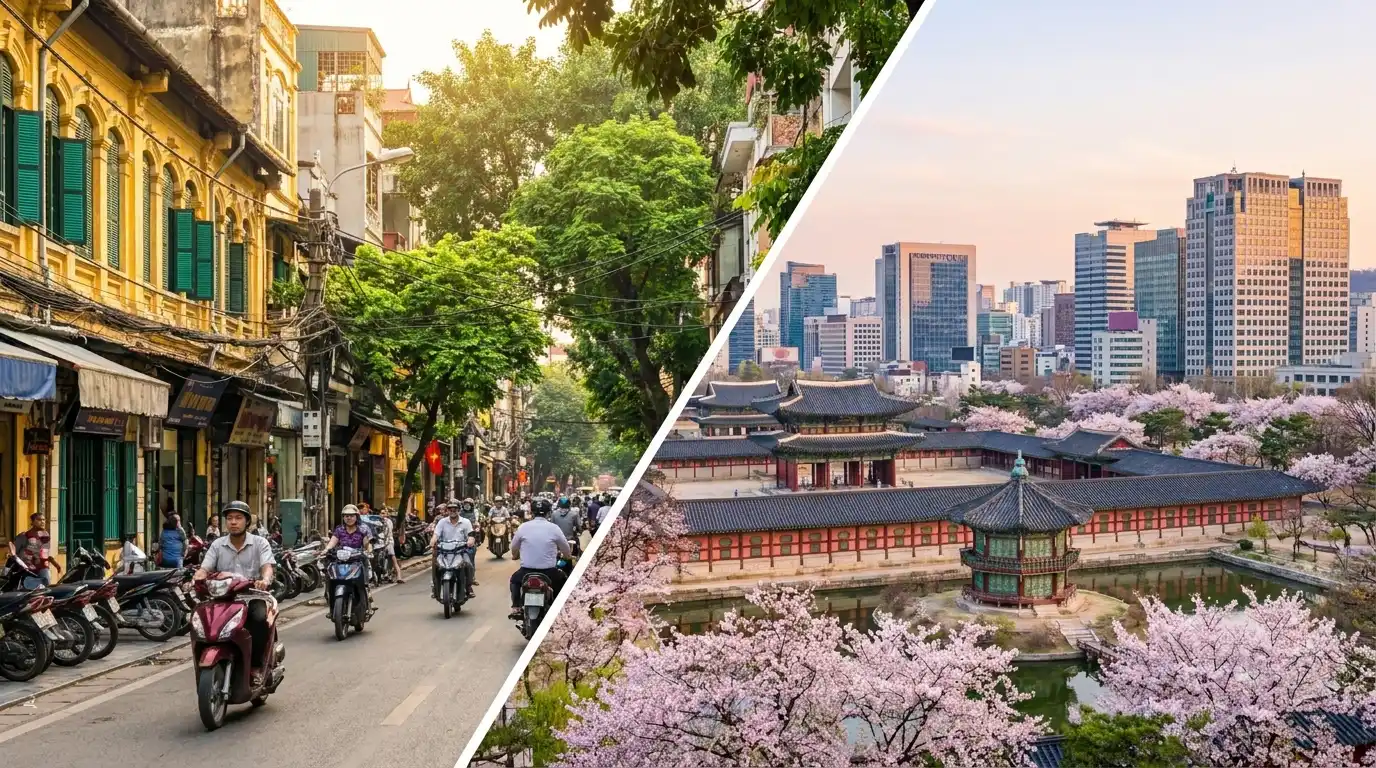
Seoul is a fascinating, hyper-modern city — but it's also fast-paced, intense, and expensive. Recovery in Seoul means navigating a major metropolis with limited options for relaxed coastal alternatives. Korean cuisine is excellent but spice-heavy, which some patients find difficult during recovery. Winters are bitterly cold; summers are hot and humid.
Vietnam offers a notably more restorative recovery experience. Ho Chi Minh City and Hanoi provide modern amenities and exceptional cuisine at much lower prices. For coastal recovery, Da Nang's beaches, Hoi An's UNESCO charm, and Phu Quoc's tropical luxury provide ideal healing environments — all easily accessible by short domestic flights. The tropical climate is consistent year-round, and the relaxed pace genuinely supports recovery.
Many international patients combine their Vietnam procedure with a proper holiday — something that's harder to arrange affordably in Korea.
Aftercare and Follow-Up
Top Korean clinics provide thorough aftercare, with detailed protocols and follow-up consultations. However, the high patient volume at popular Seoul clinics can mean less personalized post-operative attention, and ongoing communication after you return home varies significantly.
Vietnamese clinics, particularly established international-facing ones, place strong emphasis on long-term patient relationships. Most provide multiple video consultations over 12 months, responsive English-language communication, and detailed growth tracking. The smaller patient volumes at boutique Vietnamese clinics translate directly to more attentive aftercare.
Which Should You Choose?
Choose South Korea if: Budget is not a primary concern, you want access to globally renowned aesthetic specialists, you're already drawn to Korea as a destination, or you specifically want a Korean surgeon trained in techniques pioneered locally.
Choose Vietnam if: You want premium-quality results without premium pricing, prefer specialized boutique clinics over high-volume operations, value a more relaxed recovery environment, or want to combine your procedure with an affordable extended holiday.
Final Thoughts
South Korea sits at the top of Asia's hair transplant market for good reason — its surgeons are world-class and its techniques are genuinely innovative. But the gap between Korean and Vietnamese clinics has narrowed dramatically, while the cost gap has not. For international patients seeking exceptional results at honest prices, Vietnam now offers the smarter choice.
If you're weighing Seoul against Ho Chi Minh City, consider this: you can have an outstanding hair transplant in Vietnam, enjoy a two-week recovery in a tropical paradise, and still spend less than the procedure alone would cost in Korea. Reach out to a reputable Vietnamese clinic for a personalized assessment and discover why discerning international patients are increasingly choosing Vietnam.