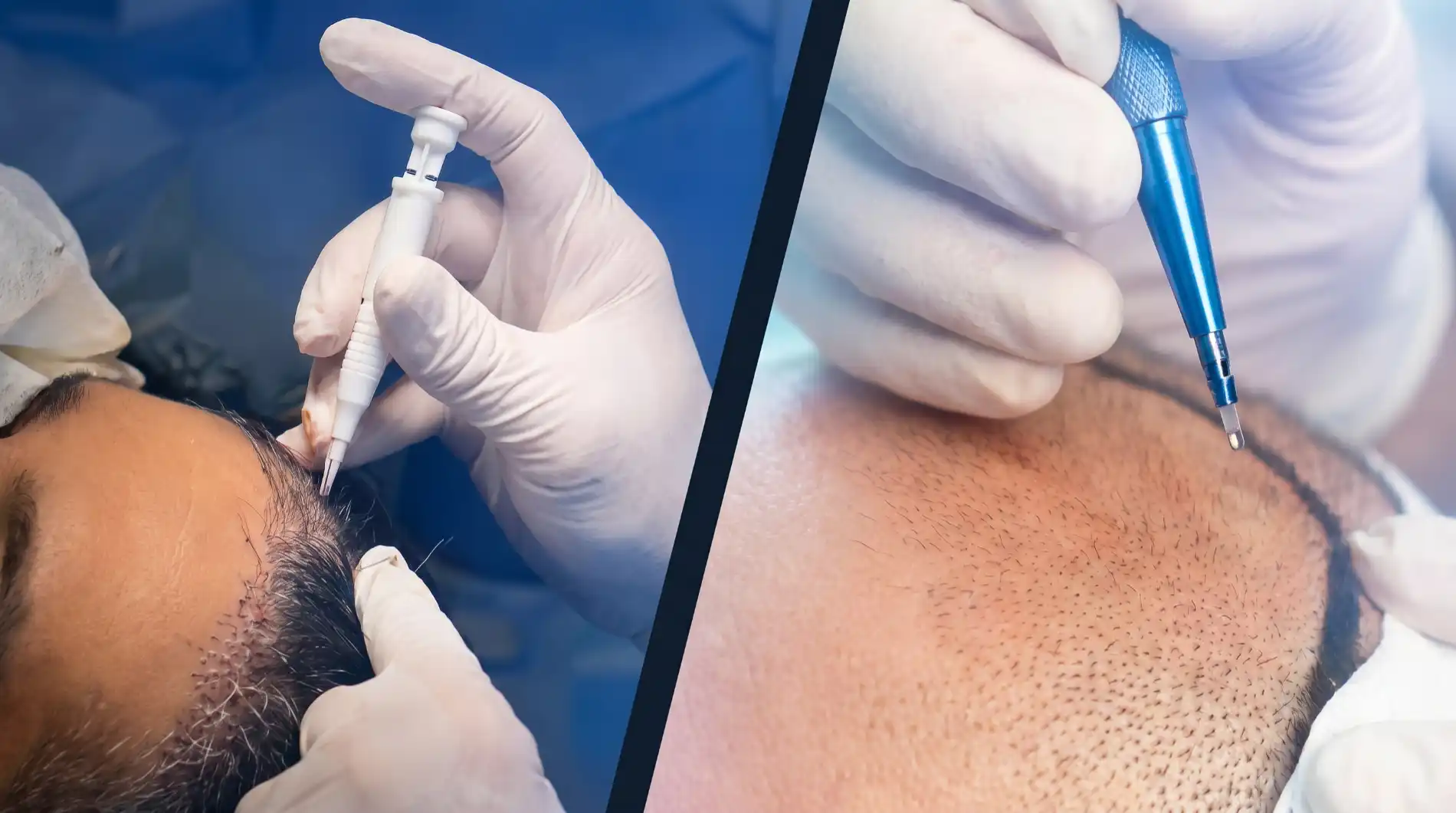
Most recovery guides are written for someone who drives home from the clinic and sleeps in their own bed that night. That's not you. You're recovering in a hotel room in Ho Chi Minh City or Hanoi, in a hot and humid climate, with a flight home booked for a date you may have picked before you fully understood what the first week looks like.
This guide walks through the real hair transplant recovery timeline — what happens at each stage, when, and why, whether you had FUE or DHI — and then answers the question international patients ask most: when is it actually safe to get on a plane?
A note before we start: the timeline below is what's typical, but your surgeon's instructions always override anything written here. Procedures differ, healing differs, and the clinic that did your work knows your specific case. Treat this as a map, not a prescription.
Hair transplant recovery timeline at a glance
- Days 1–3: the fragile window — rest, no touching, sleep elevated
- Days 3–7: scabs form and start to flake; first guided wash
- Week 2: scabs gone, redness fading
- Weeks 2–8: shock loss where transplanted hairs shed (this is normal)
- Month 3: the low point, before new growth shows
- Months 4–6: new hairs start coming through
- Months 6–12: the result arrives; judge it at a year, not a month
Each stage is covered in detail below, along with when it's safe to fly home.
The first 3 days: the fragile window
This is the period that matters most, and it's the reason your post-op stay in Vietnam isn't optional padding on your trip. It's part of the procedure.
In the first 48 to 72 hours, the newly transplanted grafts are settling into their new blood supply. They are not yet secure, and anything that dislodges them in this window can compromise the result. So the rules are strict and simple: don't touch or scratch the recipient area, don't let anything rub against it, and sleep semi-upright with your head elevated (a travel pillow and a couple of regular pillows work well) to limit swelling.
Some swelling across the forehead is normal and usually peaks around day 2 to 4 before settling. Mild soreness in the donor area at the back of the head is also expected. Your clinic will send you off with pain relief, antibiotics or anti-inflammatories if needed, a saline spray to keep grafts moist, and specific washing instructions. Follow the washing protocol exactly, because the first wash is gentler and more deliberate than you'd expect.
This is a hotel-and-rest stretch. No sightseeing in the heat, no gym, no bending over, no alcohol.
Days 3 to 7: scabs and the first wash
By now small crusts or scabs have formed around each graft. They look worse than they are. Your clinic will usually have you in for a follow-up and a guided first wash around day 3 to 5, or will have shown you the technique to do gently yourself — soaking, then letting water run over the area rather than scrubbing.
The scabs begin to soften and flake off naturally toward the end of the first week. Do not pick them. They take the dead skin with them when they're ready, and forcing them early risks pulling a graft with them.
The donor area is typically healing faster than the recipient area by this point, and most of the acute soreness has faded.
Week 2: the redness fades
Scabs should be mostly gone by the end of week two, and the redness in the recipient area starts to settle. For many people this is the point where the result starts looking tidy: short transplanted hairs in place, skin calming down.
Enjoy it, because it doesn't last.
Weeks 2 to 8: shock loss, or "where did my new hair go?"
This is the phase nobody warns patients about clearly enough, and it causes more panic emails than anything else.
The transplanted hairs fall out. Most of them. This is called shock loss, and it is completely normal and expected. It is not your transplant failing. The hair follicles stay put and healthy beneath the skin; the visible hair shafts simply shed while the follicles reset and enter a resting phase before they regrow. Some patients also shed a little of their surrounding native hair temporarily. It grows back.
If you didn't know this was coming, week 4 can feel like you flew across the world for nothing. You didn't. The work is in the follicles, not the hairs you can see.
Month 3: the low point
Around month 3 is the "ugly duckling" stage. The transplanted hairs have shed, the new growth hasn't visibly arrived yet, and the area can look thinner than you'd like. This is the hardest stretch psychologically, and it's also the most misleading. It is not the result. It's the quiet before the growth.
Months 4 to 6: new growth begins
New hairs start pushing through, fine and sometimes a little wispy or curly at first. Density builds gradually and unevenly across the area. That's normal; the whole region doesn't switch on at once.
Months 6 to 12: the result arrives
From around month 6 the change becomes genuinely visible, and by month 12 most people are seeing the bulk of their final result, with hairs thickening and maturing in texture. Some areas — particularly the crown — can keep improving up to 12 to 18 months. The takeaway: judge your transplant at a year, not at a month.
So when can you fly home?
The good news: flying itself does not harm grafts. Cabin pressure and altitude aren't the problem. Many surgeons are comfortable with patients flying within a few days of the procedure, and some clear short-haul travel even sooner. The real questions are how fragile your grafts still are and how much bumping, lifting, and friction the journey involves.
What that means in practice:
- Confirm the exact date with your surgeon before you book or change anything. This is the single most important line in this guide. A long-haul flight on day 2 is a different proposition from one on day 5, and only your clinic can advise for your case.
- If you can, build in a few days post-op before flying. Staying through the fragile window and your follow-up wash lets the clinic check the grafts and means you're not managing the most delicate phase at 35,000 feet. Many patients build this buffer into their itinerary from the start. Our guide to planning your hair transplant trip to Vietnam covers how to schedule it.
- Protect your head in transit. Don't let seat backs, headrests, or overhead bins touch the recipient area. Take an aisle seat if you can so you're not knocked when people pass, and let your head rest forward rather than back against the seat.
- Skip the hat unless your clinic clears it. A cap that touches the grafts is a risk in the early days. If your surgeon approves head covering, use only the loose protective cap the clinic provides, not a snug hat.
- Hydrate and avoid alcohol. Cabin air is very dry, and you may still be on medication. Drink water, skip the in-flight wine.
- Carry your post-op kit and saline spray in your hand luggage, and keep your clinic's aftercare instructions and contact details on your phone in case you have a question mid-journey.
Recovering in a hot climate: the Vietnam-specific bit
Vietnam is hot and intensely sunny, and direct sun on a healing recipient area is something to avoid for the first couple of weeks, both for the grafts and because the skin is more vulnerable. Stay shaded, plan any outings for early morning or evening, and keep the area dry and clean in the humidity.
That also means no swimming, no beach, no pool, and no spa or sauna in the early recovery period, however tempting the resort looks. Sweat, chlorine, and salt water are all off the table until your clinic says otherwise.
Where to spend the downtime: a gentle trip to the Central Coast
None of this means you have to sit in a hotel room. If you want to turn your recovery days into something pleasant, central Vietnam is ideal provided you keep the activities matched to where you are in your healing. Once you're past the fragile first few days and your clinic has cleared you to travel, Da Nang and Hoi An (about 45 minutes apart, with Da Nang's own international airport) make an easy, low-effort base.
The appeal here is deliberately quiet. Hoi An's Ancient Town is compact and largely shaded, comes alive in the cooler evening hours, and offers some of the best food in the country. Da Nang is the chill counterpart: riverfront strolls in the early morning or evening, an excellent coffee culture, and not much you're obliged to do. Both reward you for taking it slow, which is exactly the assignment.
What stays on the "save it for later" list: the beach (Da Nang is a genuine beach destination, but sun, sand, and salt water need to wait until you're cleared), the strenuous climbs like the Marble Mountains and Ba Na Hills, and anything involving steam, sauna, or scalp treatments. A nice way to think about it: the gentle version of the Central Coast is for now and its beach-and-adventure version is the reason to stay longer, or to come back around the six-month mark when your result has arrived and you can finally get in the water.
What a good clinic handles for you
A clinic set up for international patients should make most of this easy: a post-op kit and medication, a clear washing demonstration, at least one in-person follow-up before you leave, written aftercare instructions you can actually follow at home, and a contact channel for questions once you've flown back. Some also coordinate hotel stays timed around the recovery window. If a clinic is vague about post-op care or rushes you out the door, treat that as a warning sign. Aftercare is part of the result, not an afterthought.
The short version
Plan your trip so you're not flying during the first fragile days, expect your new hair to fall out before it grows back, protect your head in transit, stay out of the Vietnamese sun while you heal, and judge the outcome at twelve months — not at the airport.
If you're still weighing whether to have your procedure in Vietnam, a good clinic will walk you through its recovery and aftercare plan before you commit — you can book a free consultation to ask exactly how they handle the post-op stay.
This article is general information for international patients and not a substitute for the specific instructions your operating surgeon gives you. Always follow your clinic's post-operative guidance.