If you have been researching hair transplants for more than a week, you have probably hit the FUE vs DHI question. Many clinic websites tend to answer it badly, because most clinics have a technique to sell. A clinic that invested in Choi pens will tell you DHI is the future. A clinic built around high-volume FUE will tell you DHI is overpriced marketing.
We are not a clinic, so we can give you the answer most patients actually need: there is no winner. FUE and DHI are both excellent techniques, and after 12 to 18 months a good surgeon's FUE result and a good surgeon's DHI result are usually indistinguishable. What differs is the path to that result: how many grafts you can move in one session, how fast you heal, how discreet the process is, and how much you pay. This post walks you through the considerations to help you understand which technique is right for your particular situation.
FUE in one minute
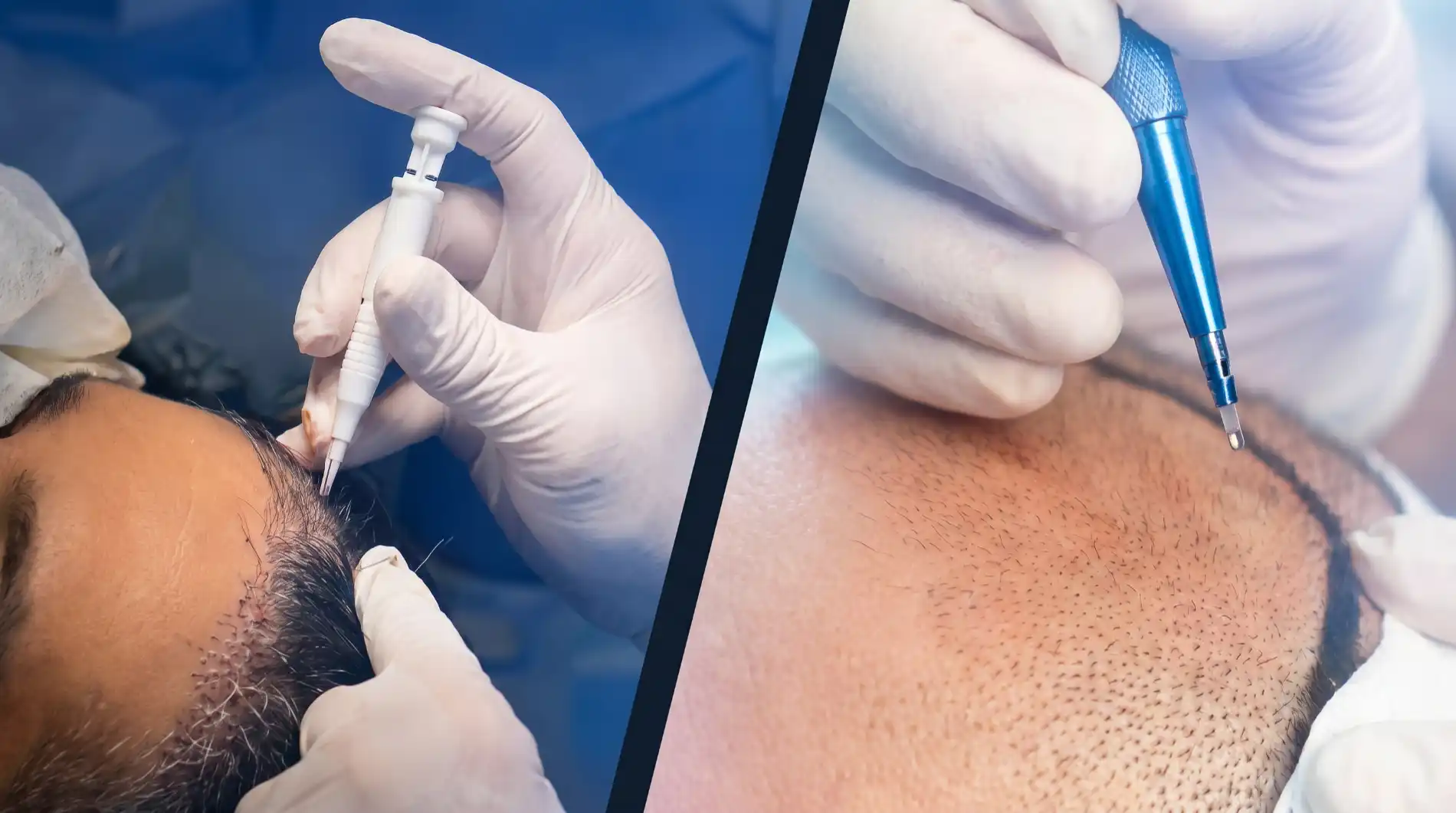
Follicular Unit Extraction harvests individual follicles from your donor area with a micro-punch, then implants them in two steps: the surgeon creates tiny recipient channels first, and grafts are placed into them afterwards. It is the most widely performed technique in the world, it leaves no linear scar, and in Vietnam it typically costs $1,500 to $3,500 for a session of 1,500 to 4,000 grafts.
FUE's strengths are capacity and flexibility. It moves more grafts per session than DHI, it costs less per graft, and it is the only technique that can harvest body hair (beard, chest, back) if the scalp donor runs short. If you want the full picture, including punch sizes, Sapphire FUE, and the complete recovery timeline, read our FUE guide.
DHI in one minute
Direct Hair Implantation is a refinement of FUE. Extraction works the same way, but implantation is different: each graft is loaded into a Choi implanter pen, and the surgeon creates the channel and places the graft in a single motion. That one change has big consequences. Grafts spend less time outside the body, the surgeon controls the angle and depth of every single graft at the moment of placement, and grafts can be packed closer together, reaching around 80 to 90 grafts per square centimeter versus 50 to 60 for standard FUE.
DHI also heals faster (3 to 5 days against 5 to 7) and can often be done without shaving the recipient area. The trade-offs: sessions are usually capped around 3,000 to 3,500 grafts because the pen-loading process is slower, and in Vietnam it usually costs more, typically $2,000 to $4,500. The full breakdown, including the Choi pen mechanics and unshaven DHI, is on our DHI guide.
The honest head-to-head: which one fits your situation
Spec tables do not make this decision for you (both our technique pages already have one). What decides it is your specific combination of goals, hair loss stage, donor supply, schedule, and budget. Let's walk through these five questions.
1. Are you fixing a hairline or covering an area?
This is the biggest fork in the road.
If your main goal is the hairline, temples, or adding density between existing hairs, DHI has a genuine edge. The Choi pen lets the surgeon set the exact angle and direction of each graft as it goes in, which matters most at the hairline where every graft is visible, and its higher packing density gets closest to how native hair grows. This is also why DHI is the usual choice for women with diffuse thinning and for repair work on a previous transplant.
If your goal is coverage, meaning a receded frontal zone plus a thinning crown, or a Norwood 4 to 6 pattern, FUE usually makes more sense. You need volume, FUE moves more grafts per session at a lower cost per graft, and across a large area the per-graft precision advantage of DHI stops being visible.
2. How many grafts do you need?
Under roughly 2,500 grafts, both techniques can do the job in one session. Above 3,000 grafts, FUE becomes the practical default: DHI sessions are capped around 3,000 to 3,500 grafts, so a large DHI case means a two-day session or two trips, with the extra cost that implies.
There is a middle path worth knowing about, because good clinics in Vietnam offer it: a combined session that uses FUE for the bulk of the coverage and DHI for the hairline and frontal zone, where the precision is actually worth paying for. For large cases with a demanding hairline, this is often the smartest approach.
3. What does your donor area look like?
If your donor supply is average or better, either technique works. If your donor is limited, from advanced hair loss, a previous transplant, or naturally low density, FUE has a card DHI cannot play: it can supplement scalp grafts with beard or body hair. A scalp donor holds roughly 6,000 to 8,000 harvestable grafts over a lifetime, and patients near that ceiling generally need FUE's flexibility. If a clinic has told you that your donor is thin, that should weigh more in your decision than anything else in this article.
4. How much downtime can you take?
DHI heals faster and looks better sooner: less crusting, less redness, and most patients are presentable at a desk within 3 to 5 days. Unshaven DHI goes further, leaving no obvious sign that anything happened, which is why it is popular with people who need to be back on camera or in meetings within a week.
FUE recovery is not dramatic either, at 5 to 7 days, but the recipient area is usually shaved and the scabbing phase is more visible. If you can take two relaxed weeks, this difference barely matters and is not worth paying for. If you are flying back to a busy office, it might be the deciding factor.
5. What is the cost difference really buying you?
In Vietnam, the same case quoted both ways typically comes out $500 to $1,500 more as DHI. Whether that premium is worth it depends entirely on the answers above.
It is usually worth paying for DHI when the work is concentrated where precision shows: hairline design, temple points, eyebrows, density between existing hair, or when an unshaven procedure has real professional value to you.
It is usually not worth paying for when you need maximum coverage across a large area on a fixed budget. Money spent on a DHI premium for a 3,500-graft crown-and-mid-scalp case would do more for your result spent on the better surgeon, or saved. A clinic that pushes DHI for every case regardless of pattern is selling equipment, not advice. Our cost guide breaks down Vietnam pricing in detail, and the cost calculator will give you a realistic range for your graft count with both techniques.
A quick word on FUT, the older strip method: it still exists and still has a niche for maximum-graft sessions at the lowest cost, at the price of a linear scar. If your case is severe and budget-driven, it belongs in the conversation, and we cover it on our FUT page.
The thing that matters more than either technique
Here is the part most comparison articles bury: the gap between an average surgeon and an excellent one is far larger than the gap between FUE and DHI. A Choi pen does not design a natural hairline, judge how your hair loss will progress over the next decade, or protect your donor from over-harvesting. A surgeon does.
This matters even more with DHI, because the technique is unforgiving of inexperience: every graft's angle is set by the hand holding the pen in real time. A skilled FUE surgeon will beat a mediocre DHI clinic every single time. So before you lock in a technique, settle the question of who is actually holding the instruments during your procedure. We wrote a full guide on exactly this: surgeon-led vs technician-led hair transplants. If you only read one more thing on this site, make it that article.
How to decide: a short checklist
Before you book anything, you should be able to answer these:
- What is my primary goal: hairline definition or area coverage? Hairline points toward DHI, coverage toward FUE.
- What is my realistic graft count? Get it from a consultation, not a guess. Above 3,000, lean FUE or a combined approach.
- What is my donor situation? Limited donor or a previous transplant points toward FUE's flexibility.
- How quickly do I need to look normal? Under a week, DHI earns its premium. Two weeks or more, it mostly does not.
- Who performs the procedure, step by step? Ask the clinic directly which steps the surgeon does personally. Evasive answers are a red flag.
- Has this surgeon done cases like mine? Ask for before-and-after photos matching your hair type and loss pattern, in the technique they are recommending.
If a clinic recommends a technique before examining your donor area and discussing your goals, that recommendation is about their pricing, not your hair.
The bottom line
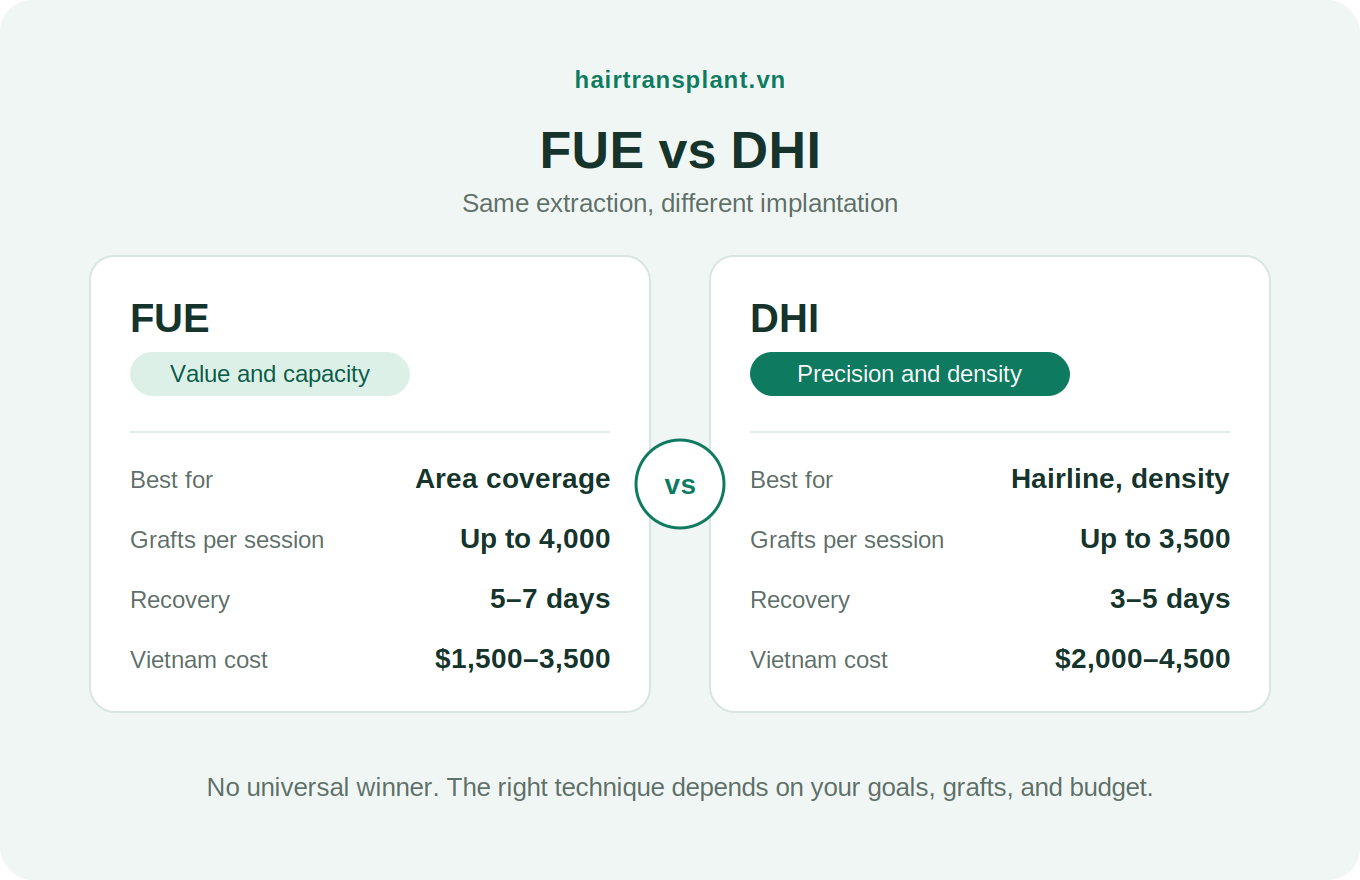
FUE and DHI are both proven. DHI buys precision, density, and a quieter recovery, and it is worth its premium for hairline-focused, smaller, or discretion-sensitive cases. FUE buys capacity and value, and it is the sensible default for larger coverage cases and limited donors. Some of the best results in Vietnam use both in one plan.
The decision you should spend the most energy on is not the technique. It is the surgeon and the clinic. That is the part we can actually help with: we vet surgeon-led clinics in Vietnam and match you with the right one for your case, free, with no obligation. Start with a free consultation and get a technique recommendation from someone who has examined your donor area rather than your wallet.