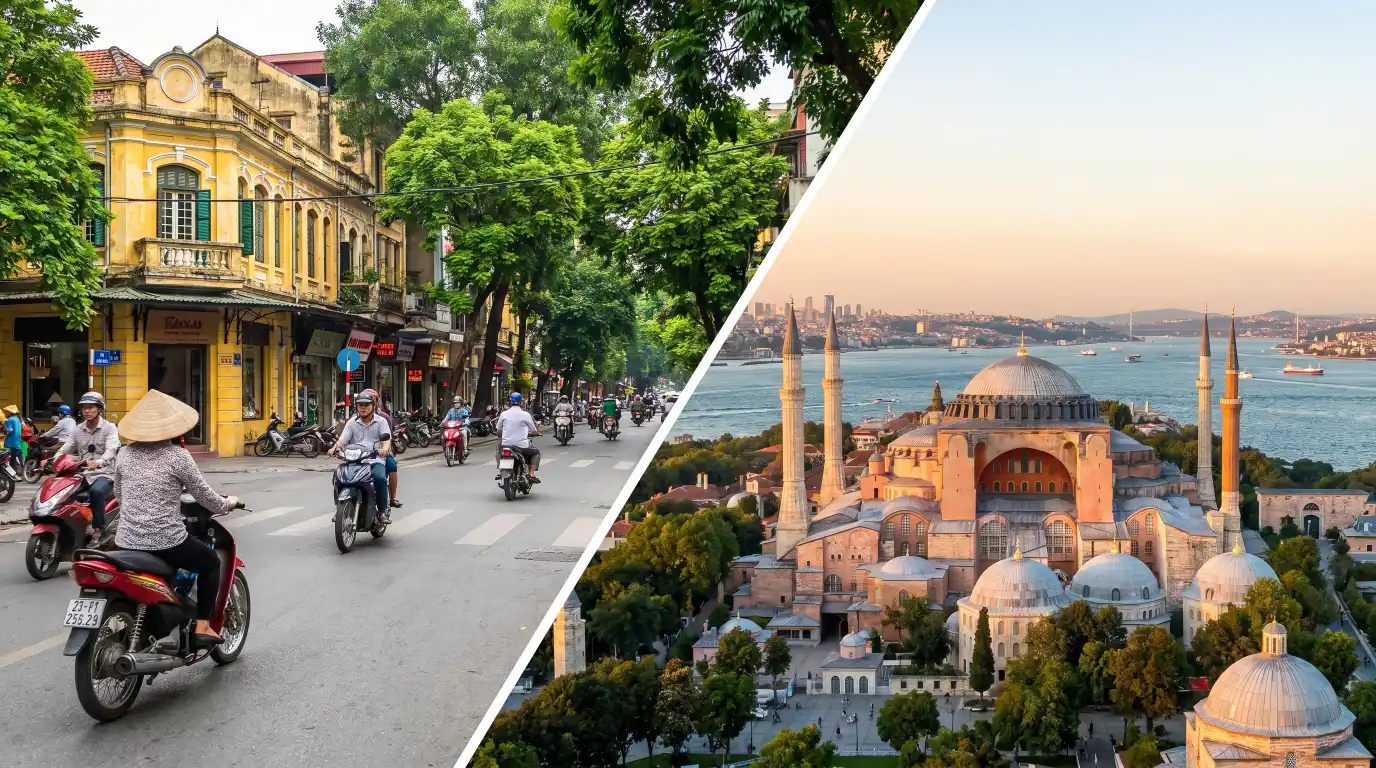
Thailand built Southeast Asia's medical tourism reputation, but Vietnam is rapidly becoming the smarter choice. Here's how Bangkok and Ho Chi Minh City compare on cost, quality, and overall experience.
Southeast Asia has firmly established itself as a global hub for medical tourism, and when it comes to hair restoration, two countries dominate the conversation: Thailand, the long-standing pioneer of medical tourism in the region, and Vietnam, the fast-rising newcomer that's quickly winning over international patients. If you're choosing between Bangkok and Ho Chi Minh City — or weighing Phuket against Da Nang for your recovery — this comprehensive comparison will help you make the right call.
Two Southeast Asian Powerhouses
Thailand has been a medical tourism destination for over two decades. Bangkok's gleaming hospitals like Bumrungrad and Bangkok Hospital pioneered the model of attracting international patients with Western-trained doctors, JCI-accredited facilities, and concierge-style service. Hair transplants became a natural extension of this ecosystem.
Vietnam entered the scene more recently but has made remarkable strides. Ho Chi Minh City and Hanoi now host clinics that match and in many cases exceed Thai standards in hair restoration specifically, while offering better value and a more personalized experience. For patients researching Southeast Asia, the question is no longer "Thailand or somewhere else?" but increasingly "Thailand or Vietnam?"
Cost Comparison: Vietnam vs Thailand
Clinics in Thailand typically charges between $2,500 and $6,000 for a full hair transplant, depending on the clinic and graft count. Premium Bangkok clinics can push higher, particularly those catering to Western expats and celebrity clientele.
Vietnam hair transplant clinics deliver comparable procedures from $1,500 to $3,500 — generally 20-40% less than Thailand for equivalent quality. This pricing gap reflects Vietnam's lower operating costs rather than any compromise on materials, technology, or surgeon expertise.
For international patients, the savings extend beyond the procedure itself. Accommodation, meals, transport, and aftercare in Vietnam are noticeably cheaper than in Bangkok, particularly for extended recovery stays. A two-week trip to Vietnam often costs less in total than a one-week trip to Thailand.
Quality of Care and Medical Standards
Thailand's reputation for medical excellence is well-deserved. The country has more JCI-accredited hospitals than any other in Asia, and its top surgeons frequently hold international fellowships. However, this premium ecosystem comes with premium pricing — and not all hair transplant clinics in Thailand operate at hospital-tier standards.
Vietnam has rapidly modernized its medical sector, with leading hair transplant clinics employing surgeons trained in the US, Europe, Korea, and Japan. Vietnamese clinics tend to specialize more narrowly in hair restoration, allowing them to develop deep expertise rather than offering it as one service among many. The result: focused, surgeon-led care with greater attention to each individual case.
Both countries have strong regulatory frameworks, but patients should always verify credentials, request before-and-after portfolios, and confirm who will actually perform the procedure (the surgeon or technicians).
Techniques and Technology
Both Vietnam and Thailand offer the full range of modern hair transplant techniques:
- FUE (Follicular Unit Extraction) — minimally invasive with no linear scarring
- DHI (Direct Hair Implantation) — using Choi pens for precise placement
- Sapphire FUE — sapphire blades for cleaner incisions and faster healing
- Long Hair FUE — preview your results immediately
- Beard, eyebrow, and body hair transplants
Vietnamese clinics have aggressively adopted the latest equipment and techniques, often investing in technology that some mid-tier Thai clinics haven't yet upgraded to. Thailand's top-tier clinics remain world-class, but you'll typically pay a significant premium to access them.
Surgeon Expertise for International Patients
Thailand has decades of experience treating Western, Middle Eastern, and Asian patients, with surgeons accustomed to designing hairlines that suit diverse facial structures and hair types.
Vietnam's leading clinics have built similar expertise more recently but with notable enthusiasm. Top Vietnamese surgeons routinely treat patients from Australia, the US, the UK, Germany, France, Korea, Japan, and across Asia, with experience spanning Caucasian, African, Hispanic, Middle Eastern, and Asian hair characteristics. The patient-to-surgeon ratio at Vietnamese boutique clinics is often more favorable, meaning more direct surgeon involvement throughout your procedure.
Travel and Logistics
Thailand benefits from extensive international flight connectivity. Bangkok's Suvarnabhumi Airport is one of Asia's busiest hubs, with direct flights from virtually every major city worldwide. Many nationalities enjoy visa-free access, and visa-on-arrival is available for most nationalities that don't.
Vietnam has caught up significantly, with Ho Chi Minh City and Hanoi now well-connected to Australia, Europe, North America, and across Asia. Vietnam's e-visa system is straightforward, and many nationalities qualify for visa-free entry of 15-45 days.
For patients flying from Australia or New Zealand, both destinations are roughly equivalent in flight time. From Europe and North America, Bangkok has slightly more direct flight options, but Vietnam is increasingly accessible.
Recovery Environment: City vs Coast
This is where the two destinations offer genuinely different experiences.
Thailand's recovery options are well-established. Recover in Bangkok with five-star hotels and world-class dining, or fly down to Phuket, Koh Samui, or Krabi for beach recovery. The infrastructure is polished, but tourist-heavy areas can feel commercialized, and prices reflect that.
Vietnam's recovery options offer comparable variety with a more authentic feel. Ho Chi Minh City and Hanoi provide modern amenities and incredible cuisine at lower prices. For coastal recovery, Da Nang offers gorgeous beaches with significantly less crowding than Phuket, while Hoi An delivers UNESCO heritage charm and Phu Quoc rivals any tropical island in the region. The overall experience tends to feel more genuine and less packaged.
Both countries have warm year-round climates ideal for healing, though Vietnam's central and northern regions experience more seasonal variation than Thailand's south.
Aftercare and Long-Term Support
Established clinics in both countries provide thorough post-procedure care, including detailed recovery instructions, medications, and follow-up consultations.
Vietnamese clinics, perhaps because they're newer to the international market and have more to prove, often go above and beyond — offering multiple video consultations over 12 months, prompt English-language communication, and personalized growth tracking. Thai clinics vary more widely; top-tier facilities provide excellent aftercare, while mid-tier ones can be less responsive once you've returned home.
Which Should You Choose?
Choose Thailand if: You prioritize a fully established medical tourism ecosystem, want access to large hospital-based facilities, value extensive flight connectivity, or already know and love Thailand as a destination.
Choose Vietnam if: You want better value without compromising quality, prefer specialized boutique clinics with more direct surgeon involvement, appreciate a more authentic travel experience, or want maximum flexibility for an extended recovery holiday at lower overall cost.
Final Thoughts
Thailand built Southeast Asia's medical tourism reputation, and it remains an excellent choice for hair transplant patients. But Vietnam has emerged as the smarter pick for many international travelers — combining specialized expertise, cutting-edge techniques, exceptional hospitality, and pricing that simply can't be matched elsewhere in the region.
If you're choosing between Southeast Asia's two leading hair transplant destinations, Vietnam deserves serious consideration. Reach out to a reputable Vietnamese clinic for a personalized assessment and discover why a growing number of patients from Australia, Europe, North America, and across Asia are choosing Vietnam over the established alternatives.